Showing posts with label 3D drawing. Show all posts

Saturday, June 11, 2016

Concavexerners

"Concavexerners" is a "short" term for "Concave Convex Corners"
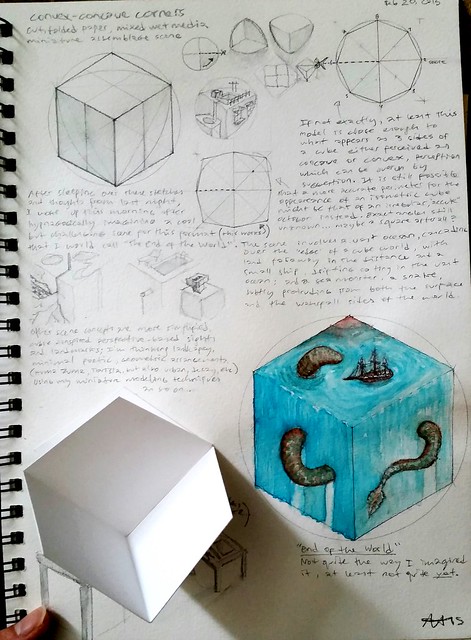
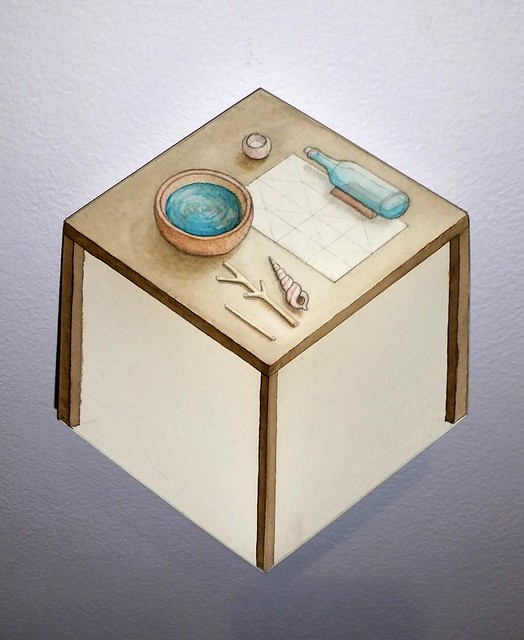
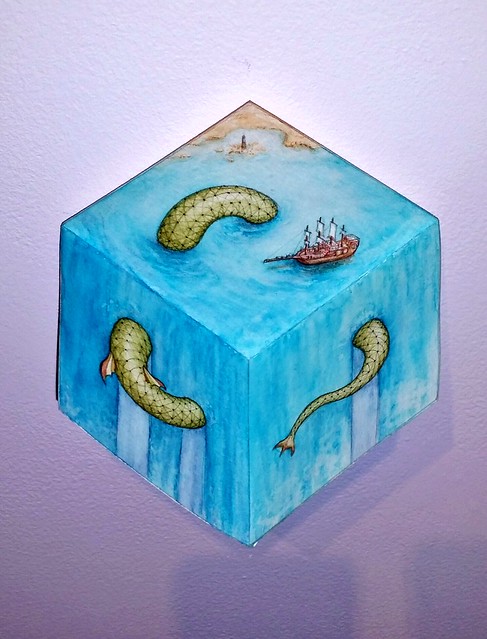
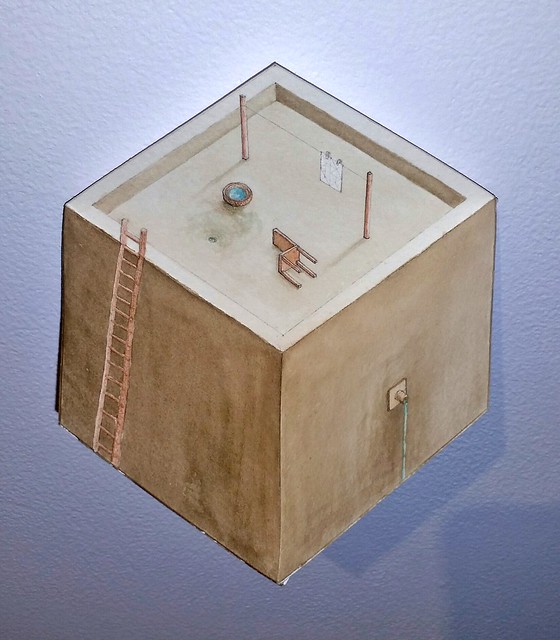
These are drawings created on concave corners that are made to appear as if they were convex structures resembling cubes. It took me some figuring out in my sketchbook before I was ready to fully draw these...


Concave Convex studies

If you are an observative nerd like me, you may have noticed that if you stare at the very corner of a room for long enough, you may be able to trick your perception into seeing said corner as if it was the protruding vertex of a cube. I could show you a context view, but instead I think I wanna leave you to wreck your brain on these a little. These are NOT what they appear to be; they are actually concave and not convex objects.


Work Table

I showed these at the Irma Freeman Center for Imagination, and seeing the actual objects is much more effective than the photographs. They produce a strange "wiggling" effect that makes them seem as though they were three-dimensional.


End of the World

Drawing these was tricky because I had to account for many factors such as viewing angle and distance. The drawings themselves had to be done following strict but "distorted" perspective lines.


Hiding Spot

Hope you enjoyed!

AA16

Thursday, November 21, 2013

Eight Spiraling Cubes


Eight Spiraling Cubes

"Eight Spiraling Cubes"
Compass and straightedge, pencil and Mahogany ink on paper.
Oct x-Nov 10, 2013
AA13


This drawing contains no real curves, only straight lines. Each cube is embedded inside the other as they turn inwards becoming ever so smaller. Is this two-dimensional figure possible in three dimensions?
Unsure on how to answer that myself, I thought I would instead share a few process sketches, and  a couple of heart-felt thoughts I wrote down during the different windows of time I spent creating this piece.

8SC process detail 3

October 12: "Just when I had thought a drawing would be so simple, I find myself working on the biggest challenge I have ever attempted. It is so hard, to the point where I start to think I just won't be able to do it, and I seriously consider giving up.
But then, a sort of creative curiosity kicks in: how would I ever find out if this seemingly impossible endeavor is simply out of reach altogether, or if it is just a little further than I could imagine?"

8SC process detail 2

October 12: "The world is resplendent with order and beauty. To this we are all still beginners, as there are infinite further layers of significance to unveil"

Eight Spiraling Cubes Phase 1

November 6: "Life is the unending work in progress"

Hey, thanks for lending an ear!
;)


AA13

Saturday, February 16, 2013

Anamorphic Vessel Drawing

So during class, I told my 7th grade students:

"I was working on this drawing of a floating vessel, and I worked so hard on making it so realistic that when I finished the drawing, it actually floated off the page!"

They were immediately skeptic, but deeply curious, as I've been known to say crazy things like that, which turn out somehow to be true (sometimes my job as an art teacher is to spark a kid's imagination and sense of enthusiasm about the world, perhaps at the expense of a little healthy dose of exaggeration!)

"What, you don't believe me?" I said, "take a look at this..."


Floating Vessel drawing

"?!... how did you do that?"

I made this "Torisian Vessel" with compass and straightedge, using a technique called "anamorphosis". In this case, it involves a common two dimensional drawing that has been "stretched" along the surface of the paper. As a result of foreshortening and perspective, when seen from a certain angle the drawing is reconstituted and appears to be three dimensional.

This is what the drawing actually looks like when viewed "straight":

Anamorphic Vessel drawing

As I usually do with projects of a more technical nature, I began by doing process sketches and studies. I first had to teach myself how to distort an image for the right effect, so after getting some more Da Vinci, Durer and Holbein into my brain, I started simple by attempting an anamorphic sphere.

Anamorphic sphere       Anamorphic sphere view

Even though it was not perfect, the anamorphic sphere sketch was good enough to at least encourage me to go a bit further. I begun doing process for the vessel idea, which in turn was informed and inspired by older notes from 2011.
2011 Vessel Sketches 1
2011 Vessel Sketches 3

2011 Vessel Sketches 4
2011 Vessel Sketches 2 Anamorphic Vessel sketches


The key challenge became to understand and translate the details of an image from a simple square grid into a distorted, stretched grid.
I arrived at a final draft, which just needed some corrections, but for the most part seemed to have worked.

Anamorphic Vessel draft     Anamorphic Vessel draft view

Then it wasn't for another couple of months or so that I finally drew the final piece, which I finished by adding some walnut ink and watercolor.

Floating vessel closeup

To check out a cool little 2 minute music clip about this drawing, click here.

Hope you enjoyed!
See you next time.


AA13


Wednesday, August 1, 2012

Stereographic Drawing

"Anima Mundi" Stereographic drawing

I created this steresocopic (or stereographic) image by hand on March 19, 2010; using compass and straightedge, ink and watercolor on paper. It was created to be viewed using a pair of special stereoscopes, and I was super excited when I found it to work.

If you would like to learn the details as to how I created this drawing, check out this older post: stereo art! and to see how I displayed the final piece, and the concept behind the artwork itself check here.

I should clarify briefly here that this image has three alternative titles: "Outer Technology Reveals Inner Technologies" is the fully installed piece and display. The stereo drawing itself is called "Axis Anima Mundi Vessel" or "Columna Cerului" alternatively.

I have recently come back to this image to try and display it in some other, more publicly accesible way. I separated the image into the individual halfs of the stereo pair and alternated and cross faded these 2 pictures to create this video:


I hope you liked that. But this post is not about reviewing old work, but about expressing my excitement for this reencounter with stereoscopy. I am now in full research and production of new works that are also sterescopic and created by hand, but will hopefully reach new interesting and ambitious goals. I am looking forward to sharing these in due time. Thanks for visiting!


AA12

Saturday, April 3, 2010

Stereo Drawing update

So, here is the final version of my stereoscopic drawing entitled "Outer Technology Reveals Inner Technologies". It works! Of course here you only get to see the stereo pair as it looks in 2 dimensions, but through the lenses the 3D effect is quite effective. To experience this piece in the right way, you can stop by The Irma Freeman Center for Imagination, for a show running until May 7th, themed: "Antiquated and Future (or Imaginary) Technology". Learn more about the IF Center and this show here.


As you may notice, the two sets are not exactly the same, and so some interesting interference is created, especially in the colors of the vessel and in the background symbols. I took some liberties as far as creating very differing patterns on the background, so that when seen in stereo, the peripheral elements are not always in 3D. The result is somewhat similar to a certain optical illusion or effect, where the central object is in focus, but the periphery appears to be in motion, until you look at it directly. I am pretty pleased with this effect: it reminds me of a quantum chamber where the particles are multiple and fluctuating, but as one peeks in, only one particle is seen in the center.


Anyhow, here are some images of how the piece was set at the IF. Just for the fun I made one into a wiggle set.


(I love how the canister of chemical next to my piece says FOTOFLAT!)

Finally, here is the statement as it was presented in the show. In there, I finally get to address the actual significance and concept behind the drawing itself, in addition to the descriptions of the optical mechanism (to see more of the initial process, ideation and sketchbook pages go to my previous post "stereo art").

“Outer Technology Reveals Inner Technologies”
Stereoscopic drawing: pen, berry ink, tea, water media on paper.
March 28, 2010

Among a few of its kind, this stereoscopic drawing done by hand highlights an optical technology that is both ancient and new, both internal and external, which is stereoscopic vision. This drawing is also a depiction of a concept which is both ancient and new as well (representing the inner technology) which is the alchemical notion of the Axis/Anima Mundi.

The reason for using a stereoscopic technology (other than the fact that 3d imaging is awesome) is that its mechanics reference the process that our own brain engages in when interpreting visual images. When looking at the (external) world, our two eyes create two separate flat images of reality; slightly different perspectives of the same object. It is our (internal) brain that compiles these two images into one three-dimensional sense. While this phenomenon is as old as our physiology and perception, we normally take for granted the amazing collaboration between external and internal technologies to create –real or otherwise- sensory experiences. It is only more recently that strong interest in this specific optical technology has re-emerged. Today we enjoy movies in 3D that appear to get closer and closer to the likeness of reality. Pretty soon we might come to confirm that what is real is always and only bound to our perception.

The depiction itself is of a personal combination meta-symbol which is very significant to me. It is the Axis Mundi, or “world spine”, which in this case I have fused to the Anima Mundi, or “soul of the world.” These are ideas that fascinate me, and that I have studied a bit. The world axis is a “tube” of sorts which connects realms to one another. Traditionally, the Axis Mundi connects the middle world to the heavens and to the underworld. It is a symbol that can take a large number of forms, and its use is rather universal. The Anima Mundi is the “soul of the world”, also known as God or Spirit, and it is the living force that animates matter, or the life source. Here I interpret the two as one, materialized as a vessel. The vessel is revealed as a type of vision; cloudy, undefined - yet clearly present- and fluctuating between being a solid object and a dream.

Like other of my works, this piece is an object that is broad in scope and multilayered. It is a material offering that references an inner realm or state, which can only be referred to metaphorically, and can only be received on an individual basis. The title of this piece is a direct reference to my most consistent (and at this point repetitive) definition of art, which is: Art is the conscious or spontaneous technology of manipulating physical matter, creating objects that reference non-physical ideas and emotions, that are in turn more closely connected to our transcendental self. An external technology such as art can reveal internal technologies such as knowledge, devotion and passion.


I was going to write more about the Axis/Anima Mundi concept here, but that would require a whole lot more writting that I don't feel like delivering right now. Instead you may be interested in checking out the Wikipedia definition of Axis Mundi. There is enough exciting stuff there to get a whole cosmic revolution started! I also need to catch up with my next post, about the first Island Vessel vivarium. Both this piece and the vivarium were shown during the GAGI (Geek Arts and Green Innovators festival), starting yesterday April 2, 2010.
Don't miss experiencing "Outer Technology Reveals Inner Technologies" while its up!
Thanks for hanging out...

AA1o